Polperro Postscripts
A blog for anyone with an interest in Polperro, publishing and people... with occasional musings on history and humanity.
Subscribe
 RSS FEED
Recent Posts
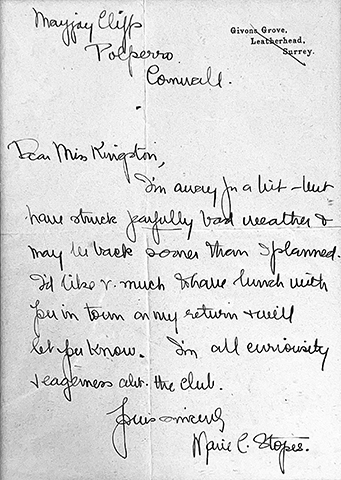 The mystery of the letter written by Marie Stopes from ‘Mayjoy Cliffs, Polperro’ and now on display in the Portland Museum, Dorset, has at last been solved thanks to a chance encounter with her grandson, Christopher Stopes, this summer.
Dr Marie Stopes was a well-known pioneer of birth control and contraception services for women in the early 1920s, following the publication of her best seller Married Love.
Mayjoy Cliffs, it turns out, is the name that Marie gave to an area of the coast below Great Lizzen to the west of Polperro, purchased by her in 1921. She had placed a notice in the Western Morning News seeking ‘Rough coast land, foreshore if possible, 3-30 acres, one mile or more from village’. Nathaniel Hocken, who farmed Lizzen, replied, offering to sell a portion of his farmland.
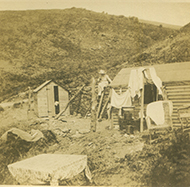
The summer of 1921 was spent fitting out two huts that she had erected on the cliff overlooking Penslake Cove. In a letter to her mother in August, she wrote:
‘We had riotous and glorious heat all through the dust and bustle of building our huts. We have cut steps and
paths and built a terrace and got a well. The place is really quite glorious… just by our house the overhanging cliff rises a sheer 300 feet from the sea. We are on a sloping platform two thirds of the way down it with a stream on our right.’
When winter storms blew part of the thatched roof off one of the huts, Marie enlisted the help of Frank Perrycoste who lived on Talland Hill with his wife Maud whom Marie had befriended during her visits to Mayjoy Cliffs from her home in Surrey.
1922-23 was a difficult period for her, as she brought a libel action against Dr Halliday Sutherland for comments made in his book Birth Control: A Statement of Christian Doctrine Against the Neo Malthusians, which she ended up losing in the House of Lords, having won in the Court of Appeal.
By 1931, however, the area around the huts suffered damage from intruders. In a letter to Nathaniel Hocken, Marie wrote:
‘I am extremely vexed and distressed to hear of the trespassing and destruction at the huts. I wish people would understand that I got that as a bird preserve and that I have got a scientific paper half written on the habits of the sea birds. It is simply abominable that there should be such goings on there. Would you mind telling this to the local policeman and see if he can do anything about it by warning people off.’
She also wrote to the RSPB, telling them that she had bought the land ‘because of my interest in seagulls which are nesting there in a very trustful, natural state, and on whom I was able to make observations which I think are novel. But since then I have been considerably hindered in carrying on these observations by the unscrupulous trespassing of hikers and others who come down even when I am there, push past me and insist on photographing them on the nests etc., as well as stealing the eggs.’
Although the land she had bought lay between two areas of the coastline west of Polperro, Marie was adamant that there was no right-of-way across hers. Her attempts to block access along the coast path by building a high wire fence cutting off much of the land beyond Freshwater and the old coastguard path and right of way made her unpopular with residents of Polperro and local boys would go out on Sundays cut it down. A petition signed by several local people was organised by Eleanor Carstairs who lived along the Warren.
In another letter in 1934, she sought the help of Sir Lawrence Chubb at the Commons and Footpaths Preservation Society, telling him ‘some of the people in Polperro were trying to arouse some trouble there about my land because I received a petition from Mrs Carstairs… In confidence I may tell you that the whole thing was stirred up by Mrs Carstairs herself. I met her in the road in Polperro and she very grievously attacked me about it.’
In a later development, the Cornish Times reported in November 1939 that ‘Dr Marie Stopes had proposed that her land should be zoned for building “so that a village on the lines of Clovelly can be erected.”
Such a proposal did not meet with the approval of the local planning officer however. Subsequently, ownership of the land passed to Marie’s son, Harry Stopes-Roe, who ensured that a footpath was established across the land which has since been maintained by the National Trust. In 2014, on his death, the land passed to his children, who still own it.