Polperro Postscripts
A blog for anyone with an interest in Polperro, publishing and people... with occasional musings on history and humanity.
Subscribe
 RSS FEED
Recent Posts
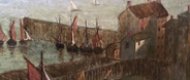
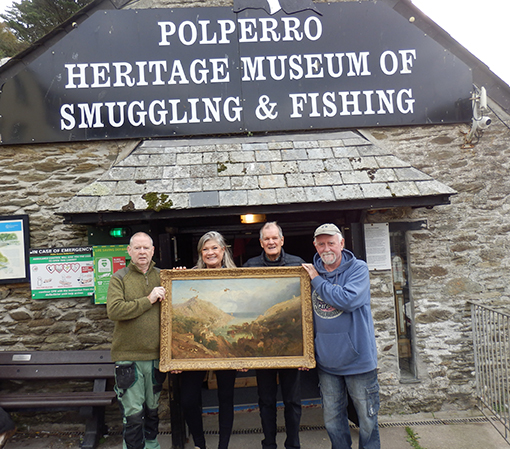 Last October, the earliest known painting of Polperro arrived at the museum there all the way from the USA, thanks to the generosity of antiques dealer Ann Pierina Killian and her family.
Ann first contacted me 15 years ago from her home in Minneapolis to tell me that she had acquired the painting at a local sale. Her eye had initially been caught by its large gilt frame and it was only later, on closer examination, that she noticed part of an old label on the back of the painting on which she could just make out the words, written in ink: ‘English Channel … purchased from the artist’s studio. Mar 19’ and an almost indecipherable date that could be 1836 ‘price 36 guineas’. The oil painting was signed ‘W. Linton’.
Intrigued, Ann searched the internet for ‘Polperro artist’ and eventually contacted me. From the photograph of the painting that she sent me, it was obviously a very early view of Polperro, depicting the inner and outer piers in the harbour and even the chapel dedicated to St Peter on the hill on the Lansallos side, long since disappeared. What look like sheep graze on the hillside and a lone rider on horseback can be seen making his way among the buildings along the Warren, unlike the exaggerated views drawn by Joseph Farington after his visit there in 1810.
There was indeed an English landscape artist named William Linton, (1791-1876) whose style was very similar to the Polperro painting. He was a Liverpool born landscape artist who moved to London where he exhibited between 1817 and 1871 and was one of the founders of the Society of British Artists founded 1824.
Ann Pierzina-Killian told me that the person who sold the painting to her had said it had come from a Victorian funeral parlour in Minneapolis where it hung for many years. What struck me, when I first saw Ann’s photograph of it, was how remarkably accurate many of the features were, given what we know of Polperro in the early part of the 19th century. How it ended up in a funeral parlour in Minneapolis is anyone’s guess. It may, of course, have been taken to the USA with one of the Polperro families who emigrated there in the 19th century.
At the time, the possibility of the painting ever returning to Polperro seemed out of the question. It clearly had a value though neither I nor Ann had any real idea of what it might be worth. Time passed, and eventually in 2016, when I contacted Ann again she mentioned a possible figure of $5,000. I posted an item about it on my Polperro Heritage Press blog in the vague hope that we could somehow raise the money either by some form of public subscription or local appeal.
Then suddenly last summer, Ann contacted me again to tell me she was planning to pay her first visit to Britain with her husband in October, and Polperro was to be one of the first stops on their itinerary. What of the Linton painting, I wondered? Ann said that she had promised it to her daughter Janelle and it was up to her as to what she did with it.
At the very least, I decided, I would at least make Ann and her husband Ron welcome on their first visit to Polperro so arranged with Catherine Stacey for them to stay in Couch’s House along with their eight-year-old grandson, Robert Curnow.
Then, a few days before she was due to arrive, Ann emailed me to say: “There have been some exciting changes as of this am!! The painting is coming home to Polperro this coming week. My daughter who now has the painting in the Twin Cities (where I found it in a garage sale many years ago). She texted me these messages after I showed her [photos of] Couch’s house. I hoped she might make that decision, but I had to let her do it on her own.”
The painting was carefully crated up by Ann’s husband and dispatched to Paul Lightfoot’s address on Talland Hill where it was duly delivered on the same day that Ann, husband Ron and grandson Robert arrived in Polperro. In the museum along the Warren, Adam Lister and Paul Dyer were on hand to assist with the unpacking before Ann posed with them and the painting for photographs of her donating the painting to the museum.
It has since undergone some restoration work by Cornish art conservationist Alison Smith and is now on permanent display at the museum.