Polperro Postscripts
A blog for anyone with an interest in Polperro, publishing and people... with occasional musings on history and humanity.
Subscribe
 RSS FEED
Recent Posts
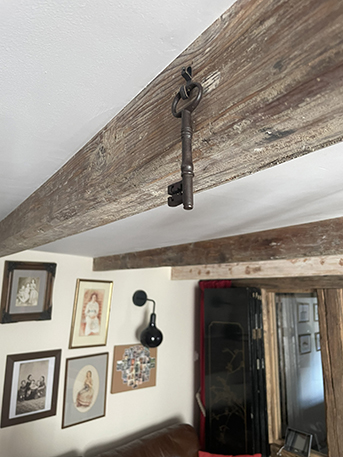 The ‘Tragic Key’ was one of the features of the Polperro Museum in the 1920s when it was housed in Couch’s House.
Although named after Jonathan Couch, the Polperro surgeon apothecary and naturalist, the building was previously occupied by the Quiller family, descended from French émigrés who came to East Cornwall during the 17th century. One branch of the family settled in Polperro where John Quiller, born in 1741, married a local girl, Jane Libby, in 1763 and the couple had ten children including three sons: Richard, William and John, all of whom played an active part in their father’s smuggling and privateering activities.
Richard, the eldest of the three Quiller brothers, commanded a privateer named the Lively during the 1793 war with France but was lost at sea at the age of 33. He had married Mary Toms in 1784 and was the father of seven children.
In later years, Jonathan Couch’s son, Thomas Quiller Couch, the grandson of Richard Quiller, recalled how his grandfather would hang the key of his quadrant on a nail on one of the beams in his home in Polperro before putting to sea with a stern warning that no one was to touch it until he returned. When he did not return from his last voyage in 1796, the key was never taken down by his wife and remained unhung from the beam for some 150 years.
Sir Arthur Quiller Couch refers to it in his novel Dead Man’s Rock in which one of the characters, Amos Trenoweth includes the following instruction in his will: ‘I command and enjoin, under pain of my Dying Curse, that the Iron Key now hanging from the Middle Beam in the Front Parlour be not touched or moved, until he who undertakes this Task shall have returned and have crossed the threshold… And the great iron key hung untouched from the beam, while the spiders outvied one another in wreathing it with their webs, knowing it to be the only spot where they were safe from my mother's broom.’
A booklet entitled ‘Polperro and its Museum’ produced in the 1920s by Fred Nettleinghame when the museum was housed in Couch’s House, says that the floor of the room ‘under the beam under which the Tragic Key hangs was a hole covered by a slate that led to an underground passage across the hearth into a place of concealment two feet square on the right of the chimney and also to the Smuggler’s Cupboard in the Primrose Room upstairs.’
The Primrose Room was named because Benjamin Disraeli is said to have dined in it when he visited Jonathan Couch in Polperro. While there is no direct evidence of Disraeli visiting Polperro, there references to him being associated with Cornish political and social circles, especially around estates such as Boconnoc. The primrose was said to be Disraeli’s favourite flower.